
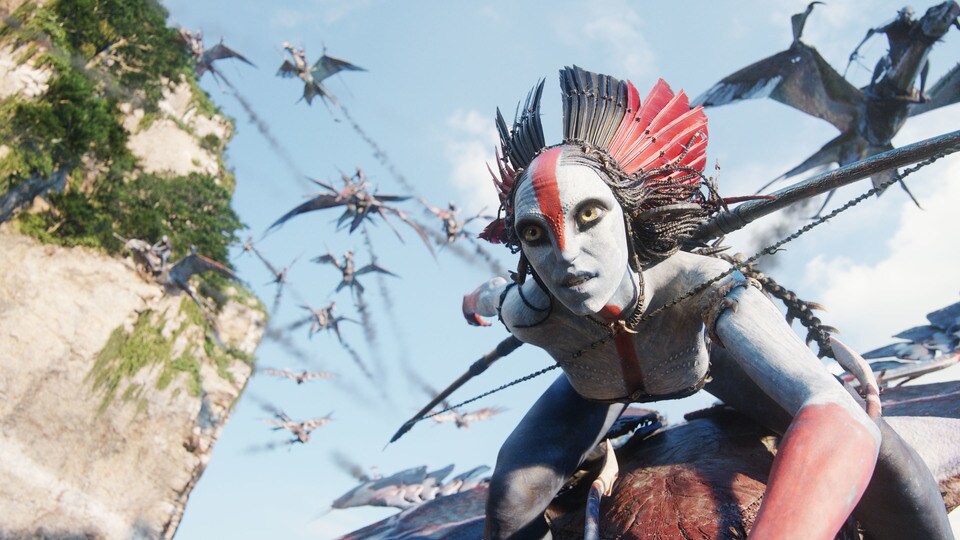

After rewatching the first two Avatar films as mental preparation, one thought kept nagging at me: I am not sure I want to sit through the same story again for another three (now two) films. So instead, I imagined a different arc — one that, to my mind, would do more justice to James Cameron’s fascination with systems, technology, and human failure than yet another white-savior myth unfolding on a moon that might more honestly have been called Oedipus rather than Pandora.
Let us begin with a brief recap of the first two instalments, before drifting — gently, and without spoilers — into What-If territory.
Avatar
Jake Sully is out of luck and out of options when a shady agency recruits him for a mission that feels experimental at best and unethical at worst. Inserted into a borrowed body, he is dropped onto Pandora and — almost immediately — into a familiar narrative groove. Jake becomes the white savior of an indigenous people, mastering their ways faster than they ever could, while quietly betraying his own species. Liberation is framed as empathy, but built on appropriation and the seductive promise of starting over as someone better, stronger, purer.
Avatar: The Way of Water
Having proven himself indispensable, Jake rises to become leader of the Na’vi. The problem is that leadership turns him into a target. His symbolic importance attracts human aggression, and his presence destabilizes the very society he claims to protect. The loss of his son marks the first real rupture in the heroic fantasy: victory comes at a price, and Jake is no longer sure who is paying it.
Avatar: Fire and Ass
The war against humanity grinds on, but now the fractures run through Na’vi society itself. Political agitators emerge, power consolidates, and moral clarity dissolves. Jake stumbles into alliances and intrigues he barely understands. Then the truth surfaces: Pandora is dying — not only because of human exploitation, but because the Na’vi themselves, under a mysterious leader, have secretly mined unobtainium and are now preparing to abandon their world. In a brutal final choice, Jake must side with his human comrades or Neytiri. He chooses — and loses her.
Fade to black.
Avatar: Out of the Frying Pan into the Aether
Jake wakes up aboard a human transit ship, moments before landing on Pandora.
Only now is it revealed that the previous three films were largely simulations — psychological training constructs based on real historical events. Their purpose was never to teach tactics, but resistance. Pandora’s true defense is not military at all: the planet and the Na’vi emit a complex pheromonal field that manipulates perception, emotion, and desire. A planetary, weaponized atmosphere of empathy. Marines do not fail because they are weak, but because they fall in love — with the world, with the people, with themselves.
Every landing so far has failed.
Broken down and rebuilt as an emotionally numbed grunt, traumatized and stripped of heroic illusions, Jake fights this time encased in a mech suit, barely insulated from Pandora’s influence. It still is not enough. Humanity is repelled once more in a bloody massacre. As the sole survivor, Jake slips aboard a departing Na’vi invasion vessel.
Avatar: Earthbound
Jake awakens alone in the Na’vi attack cruiser. Mutilated, legless, barely alive, he registers as only a partial life-form — enough to survive, not enough to be detected. He is the only one who can still stop the invasion of earth. What follows is Die Hard on a Na’vi warship: crawling through corridors, sabotaging systems, driven by memory and rage.
In the final confrontation, Jake comes face to face with the general of the invasion. The ultimate reveal: it is his twin brother — long thought dead, genuinely converted, and utterly convinced that Earth must fall. In a ferocious last fight, Jake kills him and steers the ship into the sun, saving the planet in one final desperate act.
Fade to white.
In conclusion
Having said that, Oona Chaplin and Stephen Lang are clearly the highlight of the actual third movie, locked in an over-the-top, batshit-crazy amour fou that finally injects the saga with an unhinged emotional energy it has been lacking all along — and perhaps exposes that this entire saga might just be a manifestation of James Cameron’s personal female power fantasies.
Too long for my taste, but still a genuinely enjoyable feast for the senses, borrowing heavily from its predecessors and from other cinematic epics.
| Storytelling |  |
| Characters | |
| Acting | |
| Drama, Baby! | |
| Fun | |
| Humour | |
| Visuals | |
| Music and Sound | |
| Originality | |
| Entertainment value | |
| Production value | |
| Satisfaction | |
This article was written by the author using AI as a tool for language, structure, and refinement.